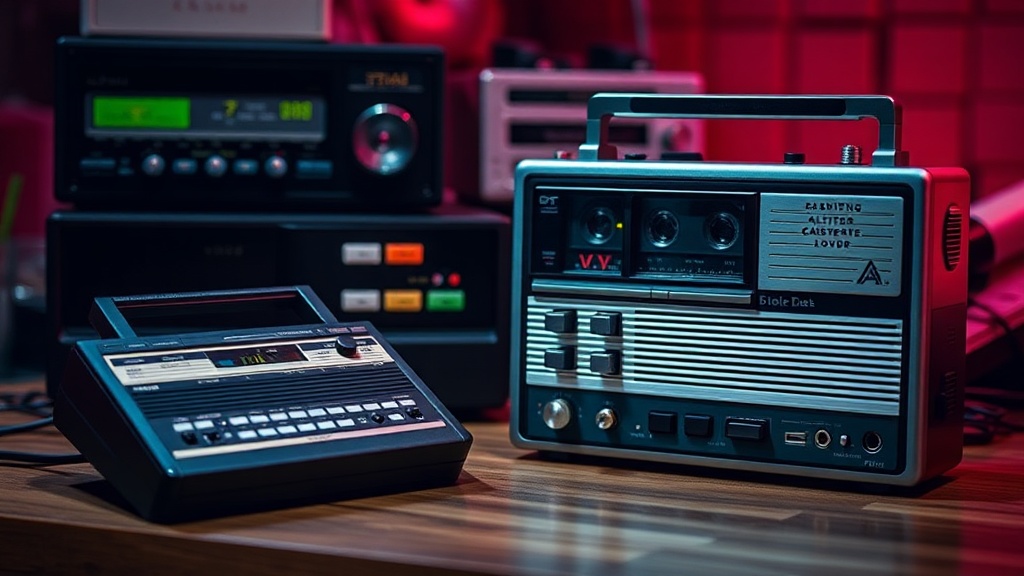
Complete Guide to Collecting Vintage Portable Cassette Players

Vintage portable cassette players occupy a unique space where audio engineering meets nostalgia-driven collecting. This guide covers everything needed to start or expand a collection: the most desirable models, what separates a display piece from a daily driver, common pitfalls that drain wallets, and where to hunt for overlooked gems. Whether the goal is reliving the walkman era or building a serious archive of portable audio history, the information here will save money—and disappointment.
What Makes a Portable Cassette Player "Vintage"?
The term generally applies to machines manufactured between 1979 and the late 1990s—the golden age before MP3 players killed the format. That said, not everything old qualifies as collectible. A vintage portable cassette player worth acquiring typically features solid construction (metal rather than all-plastic chassis), respectable frequency response (20Hz–20kHz), and repairable design. The Sony Walkman TPS-L2—the original personal stereo from 1979—remains the holy grail, though early Aiwa, Panasonic, and JVC models command serious attention too.
The market splits roughly into two camps: sealed units (never opened, often still boxed) and "user-grade" examples. Sealed units trade at premiums—sometimes 10x the original retail price—but carry risks. Capacitors degrade whether a machine runs or not. A sealed Sony WM-D6C with original belts might look pristine on a shelf, yet require complete restoration to play a tape properly.
Which Models Hold the Most Value?
Certain players consistently outperform the broader market. The Sony WM-D6C (and its professional sibling, the D6) remains the benchmark—DAT-quality recording in a portable package, still used by field recordists today. Early-production units fetch $800–$1,200 in working condition. The Aiwa HS-JX series—particularly the JX707 and JX919—offer exceptional Dolby C noise reduction and AM/FM reception in surprisingly compact shells. These regularly sell for $300–$600 depending on condition.
Lesser-known but worth watching: the Panasonic RQ-JA150 (the "Juice Box" with its distinctive vertical loading), the JVC CQ-R10H (a rare radio/cassette combo with serious audio chops), and anything from Grundig's Studio series—German engineering that prioritized sound over portability. The Marantz PMD-series portables, particularly the PMD221 and PMD430, bridge the gap between consumer and professional gear.
"The best collection isn't the largest—it's the one that gets played."
Budget Tiers: What to Expect
| Price Range | What You'll Find | Condition Notes |
|---|---|---|
| $50–$150 | Mid-tier Sony Walkmans (WM-FX, WM-EX series), Aiwa HS-G series, Panasonic RQ-SX models | Working or easily repairable; expect cosmetic wear |
| $150–$400 | Dolby C-equipped players, early discman-era cassettes, complete-in-box examples | Generally functional; may need new belts |
| $400–$800 | Flagship models (WM-D6C, Aiwa JX919), rare color variants, NOS (new old stock) units | Excellent to mint condition; collectibility premium applies |
| $800+ | TPS-L2, professional recording portables, limited editions, sealed vintage stock | Investment-grade; verify authenticity carefully |
What Should You Check Before Buying?
Portable cassette players are mechanical devices with dozens of failure points. Here's the thing—sellers often describe units as "working" when they merely power on. A true functionality check requires more.
Always verify:
- Belt condition: The rubber drive belts turn to tar after 20+ years. Replacement isn't difficult but requires patience—and sometimes custom-sized belts from suppliers like Fixer or ESRITY.
- Head wear: Playback heads have finite life. Heavy wear appears as grooves or polished channels. Retyps won't help if the head's gone.
- Capstan and pinch roller: These grip the tape. A glazed or hardened pinch roller causes wow and flutter—subtle speed variations that ruin music.
- Dolby functionality: If the deck claims Dolby B or C, test it. Switches corrode; the noise reduction circuit might be non-functional even if basic playback works.
The catch? Replacement parts for obscure models often don't exist. Sticking to popular Sony, Aiwa, or Panasonic lines means access to donor machines and third-party belt kits.
Red Flags to Avoid
Certain problems signal money pits. Steer clear of units with:
- Corroded battery terminals (unless the price reflects a parts-only sale)
- Melted plastic near the motor (overheating damage—rarely fixable)
- Visible tape path damage (bent guides, cracked shell pieces)
- "For parts/repair" listings where the seller can't explain what's wrong
Where Do Collectors Actually Find Good Players?
The hunt matters as much as the acquisition. eBay remains the obvious starting point, but prices there reflect market awareness—everyone knows what a WM-D6C is worth. Better deals hide in estate sales, church rummage sales (seriously—congregations hoard donated electronics), and Facebook Marketplace where sellers list grandpa's "old tape player" without research.
Japanese Yahoo Auctions (via proxy services like Buyee or ZenMarket) offer the deepest inventory, particularly for domestic-market models never officially exported. The Sony Walkman WM-EX1HG—the high-grade anniversary edition—appears regularly on Yahoo at prices 30–40% below eBay. Shipping adds cost, but selection compensates.
Thrift stores in affluent neighborhoods sometimes yield surprises. The Toronto area—where Soren Fernandez operates—has produced remarkable finds: a boxed Aiwa HS-JX959 at Value Village for $12, a working Grundig SCD 3790 at a church basement sale. Small-town thrift stores in Canada and the American Midwest outperform big cities. Less competition, older stock.
Online Communities Worth Joining
Reddit's r/cassetteculture (85,000+ members) offers pricing guidance and repair advice. The Stereo2Go forums host deep technical discussions—belt specifications, capacitor lists, head alignment procedures. Facebook groups like "Cassette Tape Collectors" move quickly on deals but require vigilance against scams.
How Do You Maintain a Collection?
Acquiring is only half the battle. Vintage portable players demand periodic attention. Capacitors—electrolytic ones especially—have roughly 30-year lifespans. Recapping (replacing capacitors) isn't optional for machines built before 1995 if reliability matters.
Storage matters too. Keep units in climate-controlled environments—humidity destroys belts and corrodes switches. Remove batteries before storage; alkaline leakage destroys circuit boards. For active rotation players, demagnetize heads every six months using a bulk eraser or dedicated head demagnetizer.
Cleaning the tape path with isopropyl alcohol (90%+) and cotton swabs prevents buildup that degrades sound. Don't forget the capstan—that polished metal post alongside the rubber pinch roller. It collects oxide shed from tapes. A dirty capstan causes more playback problems than worn heads.
The Belt Replacement Reality
Every vintage portable needs new belts. Full stop. Original belts are either stretched, gooey, or powdered by now. Square belts (common in 1980s Walkmans) measure roughly 30–50mm. Flat belts (Aiwa, Panasonic) vary widely. Specialized retailers like Repair Cafe networks sometimes stock common sizes, but eBay sellers offering "belt kits" for specific models save measurement headaches.
Worth noting: belt replacement requires disassembly. Document everything with photos. Those tiny screws? They strip easily. The correct driver—often JIS (Japanese Industrial Standard) rather than Phillips—prevents mangled heads.
Building a collection of vintage portable cassette players rewards patience more than money. The machines themselves tell stories—of subway commutes, mixtapes, radio recordings captured on late nights. A well-chosen player still delivers musical satisfaction that smartphones can't replicate. The mechanical engagement, the slight hiss of Dolby B, the weight of metal construction in hand—these experiences justify the hunt. Start with something reliable. Learn its quirks. Then expand.