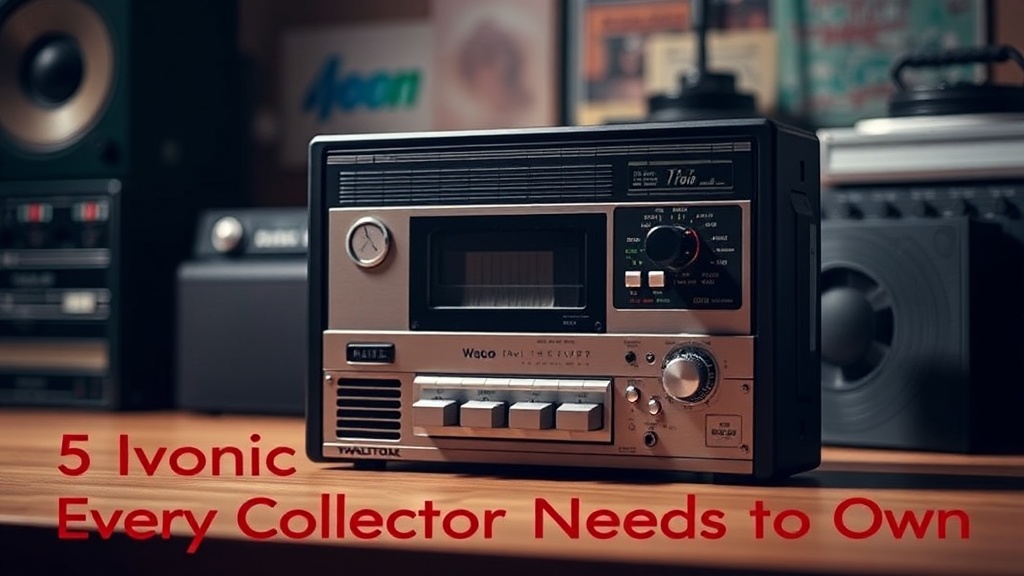
5 Iconic Vintage Cassette Players Every Collector Needs to Own

Sony Walkman TPS-L2 (1979) - The Original Portable Audio Pioneer
Nakamichi Dragon - The Audiophile's Dream Cassette Deck
Aiwa HS-JX707 - Japan's Hidden Gem with Super Bass
Marantz PMD430 - The Professional Field Recorder
Panasonic RQ-JA150 - The Ultimate Dual-Deck Boombox
This post breaks down five vintage cassette players that define the format's golden age — from pioneering portables to audiophile decks that still outperform modern alternatives. Whether you're starting a collection or hunting for a specific grail piece, these machines represent the pinnacle of analog audio engineering and cultural significance.
What Was the First Portable Cassette Player That Changed Everything?
The Sony Walkman TPS-L2, released in 1979, didn't just launch a product category — it redefined how people experienced music. Before this metallic blue marvel hit shelves, music was largely a shared, stationary activity. The TPS-L2 made it personal, private, and portable.
Designed by Nobutoshi Kihara for Sony co-founder Masaru Ibuka (who wanted to listen to opera during trans-Pacific flights), the TPS-L2 wasn't technically the first portable cassette player. The catch? It was the first one that mattered. At 390 grams and roughly the size of a paperback book, it slipped into jacket pockets with surprising ease. The dual headphone jacks — complete with that charming "Hot Line" button for voice chat — turned strangers into seatmates and friends into co-conspirators in musical discovery.
Collectors prize early Japanese-manufactured units with intact leather cases and original MDR-3L2 headphones. Prices have surged since the Guardians of the Galaxy films repopularized the TPS-L2's distinctive blue-and-silver aesthetic. A mint-condition unit with original packaging can fetch $800-$1,200 on specialty auction sites. That said, functional players in "user-grade" condition offer the same sonic experience for roughly $200-$400.
The TPS-L2's place in Sony's corporate history cements its status as more than nostalgia bait — it's a genuine milestone in consumer electronics.
Which Cassette Deck Delivers the Best Sound Quality for Serious Collectors?
The Nakamichi Dragon, produced from 1982 to 1993, represents the absolute ceiling of what cassette technology could achieve. No other deck before or since matched its combination of innovation, build quality, and sheer sonic fidelity.
What made the Dragon special? The auto azimuth correction system. Cassettes are notoriously finicky — tapes manufactured on Monday morning often performed differently than Friday afternoon batches. The Dragon's computer-controlled head assembly physically rotated the playback head in real-time to match the actual azimuth of whatever tape you fed it. This wasn't marketing fluff. You could hear it work — a subtle mechanical whir as the head adjusted, followed by soundstage expansion that made other decks sound broken by comparison.
Four glass-ferrite heads, dual capstans, and a transport mechanism that weighed more than entire boomboxes ensured rock-stable speed and vanishingly low wow and flutter. The Dragon didn't play cassettes so much as extract every bit of information pressed into oxide particles. Type IV metal tapes (TDK MA-R, Maxell MX) sounded indistinguishable from master tapes on a well-maintained unit.
Original MSRP hovered around $1,850 — roughly $6,000 in today's currency. Present-day collectors routinely pay $2,500-$4,000 for serviced examples. The transport belts degrade after 20-30 years, and replacement requires partial disassembly. Here's the thing: a Dragon with fresh belts and aligned heads still competes with mid-tier digital playback systems. That's not nostalgia talking. That's physics.
What Are the Best Portable Cassette Players from the 1990s?
While the 1980s belonged to Sony's Walkman line, the 1990s saw Aiwa and Panasonic push portable cassette performance into genuinely hi-fi territory. Three models stand above the rest for collectors seeking the format's final evolutionary forms.
The Aiwa HS-JX810 (1991) remains the benchmark for premium portable playback. It packed Dolby B, C, and S noise reduction — rare for any portable, let alone one weighing under 300 grams. The AMorphous Tape Head (developed in partnership with Tokyo Denka Kogyo) offered frequency response flat to 18kHz on metal tapes. The all-metal chassis felt substantial without becoming burdensome. Original retail prices approached $400; clean examples now trade between $300-$600.
Panasonic's RQ-SX50 represented the opposite design philosophy: extreme minimalism. At 45mm × 85mm × 17mm, it was genuinely pocketable in ways that modern smartphones aren't. The "V" series motor provided acceptable wow and flutter figures (0.08% WRMS), and the single AA battery delivered 12 hours of playback. Collectors seek out the rare titanium-finish variants released for the Japanese domestic market.
The Sony WM-DD9 occupies a strange middle ground — a portable with audiophile ambitions. It was the last Walkman to use a direct-drive quartz-locked motor, eliminating the rubber belts that degrade in lesser models. The Disc Drive mechanism pulled tape with quartz-crystal precision more commonly found in broadcast equipment. It weighed considerably more than contemporary portables (580 grams), but the stability justified the bulk. Prices for working units range from $400-$800 depending on cosmetic condition.
| Model | Weight | Key Feature | Current Market Value |
|---|---|---|---|
| Aiwa HS-JX810 | 290g | Dolby S + AMorphous head | $300-$600 |
| Panasonic RQ-SX50 | 95g | Ultra-compact design | $150-$300 |
| Sony WM-DD9 | 580g | Quartz-locked direct drive | $400-$800 |
Are Vintage Boomboxes Worth Collecting in 2024?
Absolutely — though the market has stratified sharply between "ghetto blasters" as cultural artifacts and genuinely capable portable stereos. The JVC PC-100 (1981) and Conion C-100F (1983) command thousands from hip-hop memorabilia collectors, but audio performance remains secondary to aesthetic impact.
For collectors prioritizing sound, the Panasonic RX-DT680 offers the best balance of performance, durability, and reasonable acquisition costs. Part of Panasonic's "Shockwave" series, the RX-DT680 packed twin 4-inch woofers with passive radiators, separate tweeters, and a cassette section derived from their hi-fi separates line. The "Bi-wiring" configuration (separate amplifier channels for woofers and tweeters) actually delivered audible improvements over single-amp designs.
The detachable speakers could spread 1.5 meters apart, creating genuine stereo separation impossible with integrated designs. At 7.2 kg with eight D-cell batteries installed, it wasn't truly portable — but that's not the point. The RX-DT680 turned beaches, parks, and stoops into temporary sound systems.
Common failure points include degraded speaker surrounds (easily replaced with modern butyl rubber) and corroded battery contacts. Worth noting: the RX-DT680's cassette mechanism shares parts with several Technics portable decks, making repairs possible for anyone with patience and a service manual. Working units sell for $150-$350 depending on cosmetic condition and whether the original shoulder strap survives.
The Grammy Museum's hip-hop collection recognizes the cultural significance of high-quality boomboxes in the genre's development — these weren't just playback devices, they were instruments of public sonic architecture.
How Do You Choose Between Collectible and Usable Cassette Players?
This question divides the cassette collecting community more than any other. Some collectors pursue sealed, boxed units as investment-grade artifacts. Others seek daily drivers that justify the format's continued relevance. Neither approach is wrong — but they require different strategies.
The Technics RS-M85 (1979-1982) illustrates this tension perfectly. It's a stunning deck — champagne gold finish, fluorescent peak meters, direct-drive capstan with quartz lock, and build quality that makes contemporary equipment feel like toys. Technics manufactured it during Matsushita's golden age, when engineers seemingly had unlimited budgets and no fear of over-engineering.
But the RS-M85 uses a complex transport with idler wheels, tension arms, and mechanical logic controls that demand regular maintenance. A "mint" unit that's sat in climate-controlled storage for 40 years often performs worse than a "good" unit that's seen annual use. Rubber hardens. Capacitors drift. Lubricants congeal.
Here's the thing: the best collector's item is one you'll actually use. Cassettes are an analog format — they degrade with each play, sure, but so do the machines if they sit idle. The capacitors in power supplies dry out whether you're listening or not. Belts develop flat spots and memory creep. A working RS-M85 with some cosmetic wear represents better long-term value than a pristine unit with original seals intact.
Practical advice: budget 20-30% of purchase price for immediate servicing. New belts, cleaned heads and capstans, recapped power supplies, and fresh lubrication transform "working" into "excellent." Find a technician familiar with vintage audio — the AudioKarma forums maintain regional repair recommendation threads that can point you toward qualified service providers.
The RS-M85 currently trades between $400-$700 for serviced examples. Unserviced units appear cheaper ($200-$350) but often require $150-$250 in professional attention before they'll perform to specification. The math usually favors buying already-serviced equipment from reputable sellers who offer warranties.
"The best vintage audio equipment combines mechanical sophistication with acoustic transparency. These machines don't color the sound — they reveal what the engineers captured in the original recording sessions."
Each of these five players represents a different approach to the cassette format's possibilities. The Sony TPS-L2 made music mobile. The Nakamichi Dragon extracted maximum fidelity from a fundamentally limited medium. The Aiwa HS-JX810 and Panasonic RQ-SX50 refined portability to its logical extremes. The Technics RS-M85 and Panasonic RX-DT680 proved that serious audio performance didn't require component-sized equipment.
What ties them together? They were built to last. In an era of disposable electronics, these machines persist — demanding occasional maintenance, rewarding attentive ownership, and delivering experiences that streaming services can't replicate. The mechanical engagement of loading a tape. The satisfying clunk of a well-damped transport. The warm, slightly compressed sound of chromium dioxide tape through quality heads.
Start with whichever model speaks to your collecting priorities — portability, fidelity, or cultural significance. Just don't wait too long. The supply of working vintage equipment isn't growing, and the community of enthusiasts who appreciate these mechanical marvels certainly is.